How Poor Sparger Design Ruins Oxygen Transfer in High-Density Fermentation

Pumping air into a fermenter does not guarantee that oxygen reaches the cells. In high density fermentation, cells consume oxygen faster than almost any other nutrient, and the sparger decides how much of it actually dissolves. If the sparger makes oversized bubbles, or thick culture clogs its holes, the bubbles rise too quickly to transfer much oxygen. Supply then falls behind demand, and the cells slow down, produce unwanted by-products and, in the worst case, die.
Oxygen is usually the bottleneck
In high-density bacterial and fungal fermentation, oxygen almost always limits growth. Two terms matter here:
OUR (Oxygen Uptake Rate): how fast the cells use oxygen
OTR (Oxygen Transfer Rate): how fast the fermenter supplies oxygen

When OTR falls below OUR, the cells run short of oxygen. They switch to other pathways and make side products such as lactate or acetate. They become stressed, and eventually the whole culture can collapse.
Oxygen transfer efficiency therefore becomes a critical factor in maintaining a balance between OTR and OUR. One of the most important factors affecting OTR is the size of the air bubbles inside the fermenter.

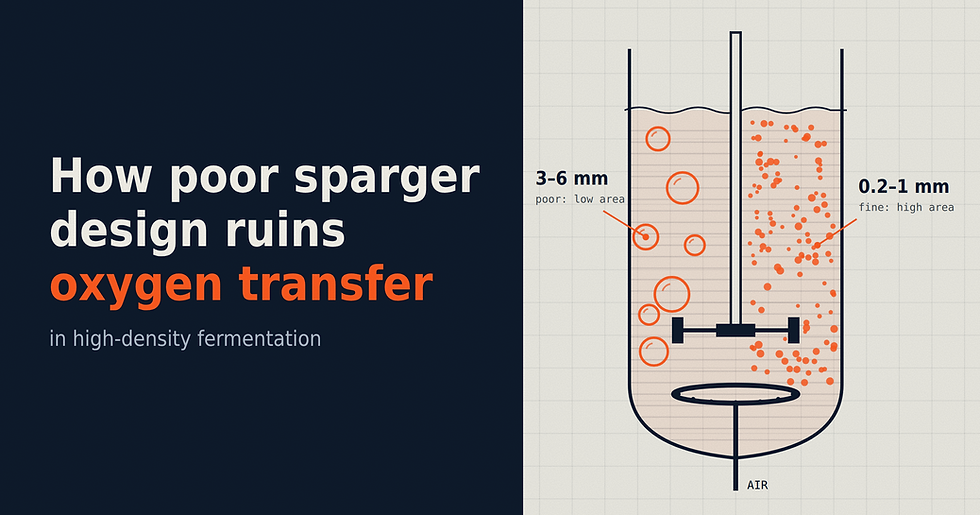
Oxygen enters the broth across the surface of each bubble. Smaller bubbles provide a larger total surface area for gas-liquid contact and remain in the liquid longer, allowing more oxygen to dissolve. In contrast, a poorly designed sparger may produce large bubbles, often greater than about 3 mm in diameter. These bubbles have a lower surface-area-to-volume ratio and tend to rise quickly, reducing the time available for oxygen transfer. As a result, a significant amount of oxygen may escape from the broth without being effectively utilized by the cells.
3 ways standard spargers fail in dense cultures
Big bubbles and low surface area
Standard pipe and ring spargers have large holes (about 1 to 3 mm). They work fine in thin liquids. But once cell density passes about 50 to 100 g/L dry cell weight, the broth becomes thick. Big bubbles then merge into large plumes and shoot straight up past the impeller. They spend very little time in the liquid, so little oxygen dissolves.
Clogging and fouling
Thick cultures leave deposits on the sparger: sticky biopolymers, clumped cells and media residue. Ring spargers also push gas unevenly through their holes. When a few holes block, all the air rushes through the rest. The result is huge bubbles and uneven gas flow.
Too much agitation and foam
When the sparger can’t supply enough oxygen, people turn up the impeller speed to break bubbles by force. This causes two new problems:
Cell damage: delicate cells and filamentous strains can be torn apart by shear.
Heavy foam: high gas flow plus high speed builds thick foam that can block exhaust filters and vent lines.

What to look for in a custom sparger
Off-the-shelf parts often can't solve oxygen problems. A custom-designed sparger should consider:
Hole spacing and gas speed: correct spacing stops bubbles merging right at the sparger.
Surface treatment: polished or specially coated surfaces make it harder for biomass to stick and block holes during long runs.
Dual sparging: use a micro-sparger early, when oxygen demand rises fast. Switch to a macro ring sparger near peak density, when high gas flow would cause foam. This can help keep dissolved oxygen above a target such as 30%, though the right setpoint depends on your organism.
Position near the impeller: place the sparger so gas enters the high-shear zone of the bottom impeller. Bubbles break up immediately, before they can merge.
The bottom line
In high-density fermentation, the sparger is not an accessory. It is a core part of the oxygen delivery system. Poor bubble formation, bad placement, clogging and mismatched design choices quietly cap your OTR, reduce yield and make scale-up unpredictable.


Comments