Batch, Fed-Batch, or Continuous? Choosing the Right Feeding Strategy for Precision Fermentation

Updated: Jul 28
In the rapidly evolving landscape of precision fermentation, achieving high titer, yield, and productivity is paramount. Yet, one of the most critical decisions facing bioprocess engineers and lab managers isn’t just what microbe to use, but how to feed it.
The choice between Batch, Fed-Batch, and Continuous (specifically Perfusion) culture systems fundamentally dictates your process economics, facility footprint, and downtime. This guide maps out the technical differences and strategic advantages of each, helping you map the right path to maximize yield and minimize costly interruptions.
The Baseline: Simple Batch Process
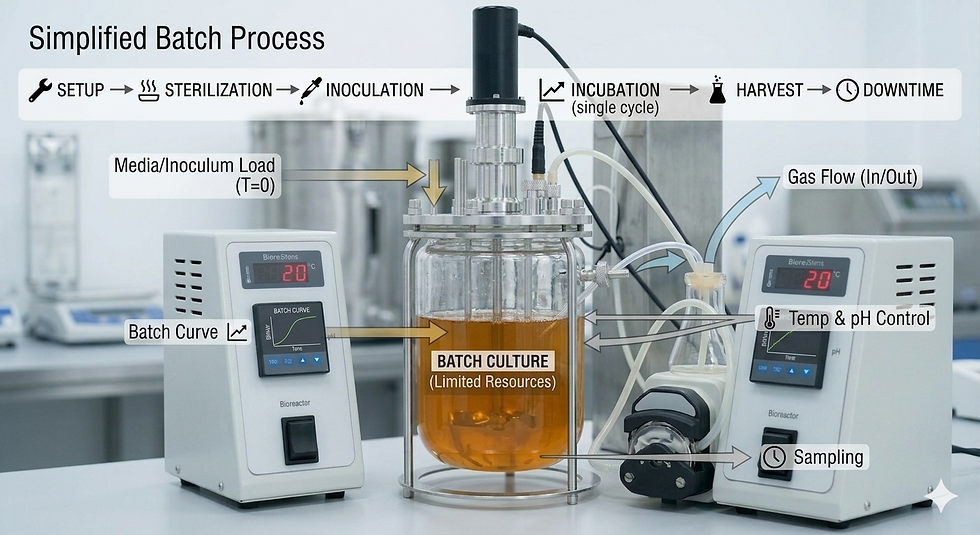
The simplest form of upstream bioprocessing is the Batch process. In this mode, the bioreactor is filled with a defined medium, inoculated with the production microbe, and allowed to run until the nutrients are exhausted or waste products reach toxic levels. It is a closed system (except for airflow and pH control).
This strategy is straightforward, featuring a low barrier to entry and minimal complex equipment
When to Choose Batch:
Early-Stage R&D: When rapidly screening strains or media formulations.
Low-Value Products: Where the minimal operational complexity outweighs the lower final yield.
Simple Processes: When the microbe is robust and not susceptible to substrate inhibition (e.g., high sugar concentration doesn't hinder growth).
The Downside: Batch culture inherently leads to low biomass densities and low product titers. You also face significant downtime between runs for cleaning, sterilization, and re-setup.
Introducing Complexity: The Fed-Batch Strategy
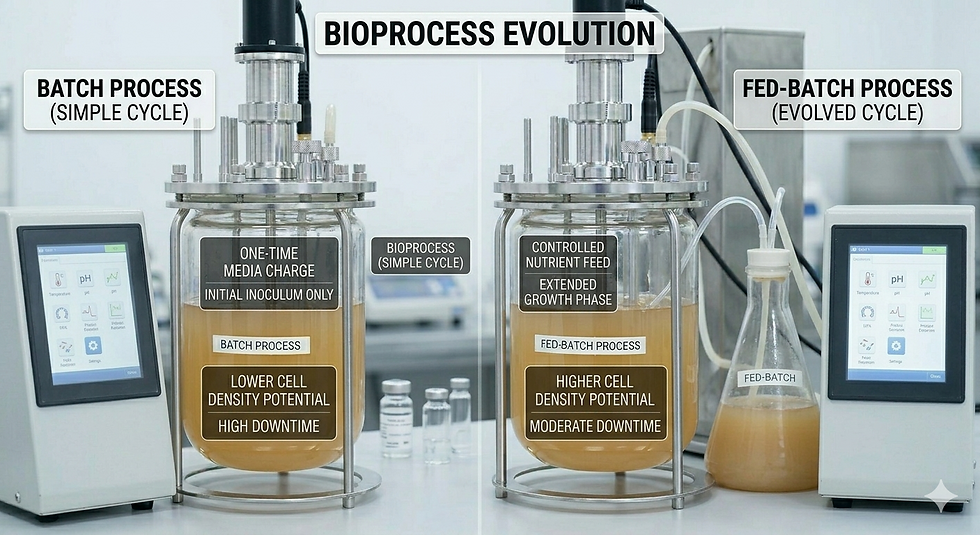
To overcome the limitations of nutrient limitation and substrate inhibition, most industrial processes utilize a Fed-Batch strategy. In this mode, the cultivation starts like a batch process, but crucial nutrients (like glucose) are fed into the bioreactor during the run (the 'feed'). This keeps the nutrient concentration at an optimal level, allowing the culture to achieve much higher biomass and product densities than a simple batch.
This setup is significantly more complex, requiring precise control over the feeding rate.
When to Choose Fed-Batch:
Maximizing Titer: When your primary goal is achieving the highest possible concentration of product (titer) at the end of the run.
Substrate Inhibition: When high initial concentrations of a substrate (like glucose) would inhibit microbial growth.
Standard Industrial Production: This is the de facto standard for most recombinant protein and secondary metabolite productions (like antibiotics).
The Downside: While yield is high, it is still a batch process. The run eventually ends, requiring significant downtime for harvesting, cleaning, and sanitization. The equipment is also more expensive and complex to operate than a simple batch setup.
The Ultimate System: Continuous Perfusion
The most advanced feeding strategy is continuous culture, and in precision fermentation, this often means Perfusion. Unlike the discrete 'runs' of batch and fed-batch, perfusion aims for a steady state.
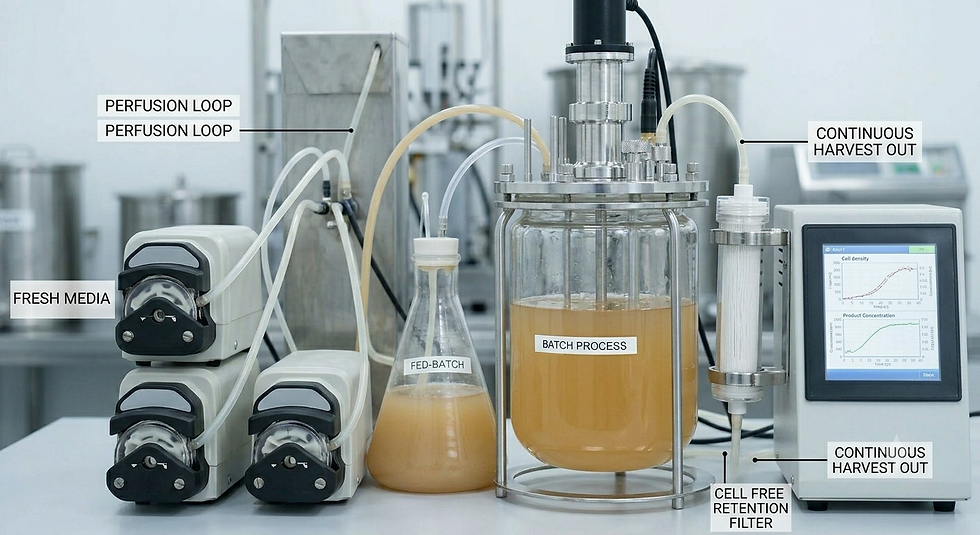
A perfusion system continuously adds fresh media while simultaneously removing waste and, crucially, harvesting the product while leaving the producing cells inside the reactor. This is achieved using a cell retention device (like a hollow fiber filter). The reactor can run for weeks or even months, dramatically minimizing downtime.
When to Choose Perfusion:
Maximizing Volumetric Productivity: Perfusion systems achieve extremely high cell densities and maintain them at a steady state, leading to unparalleled daily output for a given reactor size.
Unstable Products: When the product is fragile or susceptible to degradation if left in the bioreactor for days (as in fed-batch). Perfusion harvests the product continuously, often within hours of production.
Minimizing Downtime: By running continuously for weeks, you virtually eliminate the frequent turnaround time (cleaning, sterilization, media prep) that plagues batch processes.
The Downside: High capital expense, extreme operational complexity, and a high risk of contamination over long run times. Specialized equipment, like the cell retention devices shown above, is required.
Conclusion: Making the Right Choice
The feeding strategy you choose for your precision fermentation process dictates your yield, your schedule, and your capital expenditure.
Strategy | Complexity | Relative Yield | Product Stability | Operational Downtime | Investment |
Batch | Low | Low | Low | High | Low |
Fed-Batch | Medium | High | Medium | Medium | Medium |
Perfusion | High | Very High | High | Very Low | High |

Great👍
👍