Beyond the Filter: How Tangential Flow Filtration (TFF) Is Changing Modern Bioprocessing

Updated: Jul 28
The landscape of modern biotechnology is moving at a breakneck pace. Whether we are looking at life-saving biopharmaceuticals, next-generation vaccines, precision fermentation for sustainable ingredients, or cell-based therapies, and the core demand remains identical: industries need higher efficiency, pristine product quality, and processes that can scale seamlessly without breaking the bank.
For decades, separation in bioprocessing was treated as a brute-force exercise simply stripping out impurities or capturing solids from liquids. However, as biological products have grown infinitely more complex and regulatory standards more stringent, traditional filtration methods have begun to hit a wall. TFF has emerged as the smarter, more elegant solution, allowing companies to radically boost productivity while fiercely protecting product integrity.

Understanding TFF: More Than Conventional Filtration
To appreciate why TFF is turning heads, it helps to look at how it fundamentally reengineers the mechanics of separation.
In conventional "dead-end" filtration, the liquid feed stream is pumped directly at the membrane surface. It works well enough initially, but it has a massive design flaw: over time, rejected particles rapidly pile up on the membrane. This creates a dense cake layer, leading to severe membrane fouling, a steep drop in flow rate, and frequent, costly interruptions to clean or replace the filters.
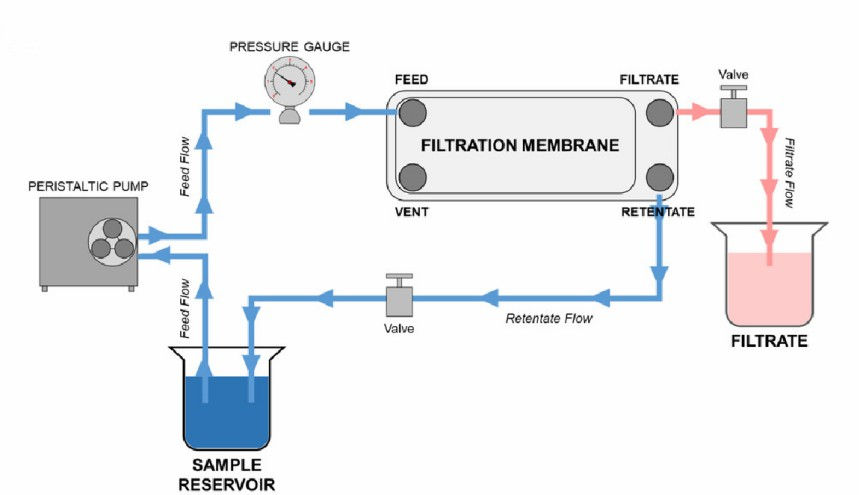
Tangential Flow Filtration flips this script entirely. Instead of forcing the liquid directly into a dead end, the feed stream is pumped parallel (tangential) to the membrane surface.
As the liquid sweeps across the membrane, a portion passes through as filtrate (permeate), while the rest is recirculated as retentate. This continuous, rapid crossflow acts like a self-cleaning broom, sweeping away accumulated particles and minimizing foulant buildup.
The immediate operational benefits of this design include:
Drastically Reduced Fouling: Lower particle accumulation means sustained high flow rates over long periods.
Gentler Hydrodynamics: The parallel flow minimizes localized pressure spikes, protecting delicate biological structures from shear stress.
Extended Equipment Life: Membranes last significantly longer, driving down consumables costs.
Continuous Operation Suitability: Because it doesn’t clog instantly, TFF integrates perfectly into modern, continuous manufacturing setups.
Why TFF Matters in Modern Bioprocessing
Bioprocessing today isn’t just about making a product; it’s about making it reliably, cleanly, and economically. TFF shifts the needle across several key manufacturing goals.
1. Maximizing Product Recovery
Biological targets like monoclonal antibodies, recombinant proteins, and viral vectors are incredibly delicate and highly valuable. Traditional processing methods often subject these molecules to harsh mechanical stress or trap them inside filter cakes, leading to devastating yield losses. TFF handles these fluids with extreme care. By tightly controlling trans-membrane pressure (TMP) and crossflow velocity, manufacturers can recover maximum product while keeping molecules intact.
2. Gentle, High-Concentration Processing
Biomolecules are frequently harvested in highly diluted volumes. Before they can be purified or packaged, they must be concentrated. Traditional thermal evaporation can denature sensitive proteins. TFF achieves rapid, highly efficient concentration at ambient or refrigerated temperatures, preserving the native state and stability of the product.
3. Seamless Buffer Exchange (Diafiltration)
Downstream processing requires products to transition through various chemical buffers to maintain stability or prepare for formulation. Historically, this meant tedious, multi-step resin chromatography or centrifugation steps. TFF incorporates diafiltration, a process where buffer is added to the formulation at the same rate permeate is removed. This allows for simultaneous washing, salt removal, and buffer exchange in a single, elegant step.

The Crucial Choice: Membrane Selection
The magic of a TFF system is highly dependent on its core component: the membrane. Choosing the right material is a balance of biology and engineering.
Membrane Type | Core Advantages | Typical Applications |
Ceramic Membranes | Extreme physical durability, high temperature/chemical resistance, and exceptionally long operational life. | High-fouling biomass harvesting, extreme pH clarifications, and industrial fermentation. |
Polymeric Membranes | Highly cost-effective, disposable options available, highly flexible configurations, and minimal non-specific binding. | Biopharmaceutical proteins, delicate enzymes, and single-use clinical trial manufacturing. |
Looking Forward: Smarter, Integrated Systems
The future of TFF lies in automation. The industry is rapidly moving away from manually tweaked standalone units toward fully integrated, smart TFF systems. By pairing automated control loops with real-time pressure, flow, and inline UV sensors, modern TFF systems can dynamically adjust operating parameters on the fly to prevent fouling before it starts.
Ultimately, TFF has evolved from a simple filtration alternative into a fundamental enabler of modern biotechnology. By bridging the gap between delicate laboratory discoveries and robust industrial scale, it ensures that the next generation of life-changing bio products can reach the world safely, efficiently, and consistently.


Very informative article! A clear explanation of how TFF is driving innovation in bioprocessing and improving downstream efficiency in modern biotech applications.
Detailed, educational, and extremely relevant for anyone interested in bioprocess innovation.
Great
Fabulous
Great